Paint
Branch Unitarian Universalist Church
Gaza
at the Crossrads: The History of My Family’s Hometown
Philip
Farah
Feb
22, 2009
Al
Salamu Alaykum. Shukran to…
I
was born in Jerusalem in 1952.
However, I’m ¾ Gazan—my father’s family and my maternal grandmother’s
family both have centuries old roots in that City. Most people are surprised when I tell them about the many Palestinian
Christian families that come from Gaza, like mine does. In the minds of most people in the
West, Gaza is the home of Muslim Hamas, which has been vilified to no end in
the Western Media. But the anger
that Hamas represents is the anger of those who are oppressed, those who have
been under the boot of a brutal occupation for over forty years, and it is an
anger that is shared by the many Christian families that call Gaza their
hometown, as mine does. One of the
largest neighborhoods of the old part of Gaza is al-Zaytoun (meaning the Olive
Grove) and it was known for centuries as the Christian Quarter.
However,
I believe that anger will not help solve Palestinian-Israeli conflict. What I hope to present in this
introduction are a few examples of glorious periods in Gaza’s 5,000 year
history, and illustrate that these were possible because of the City’s
tolerance of diversity during those periods. When one group sought dominance over all others in Gaza, the
result was death and destruction and long periods of stagnation.
I
will start by showing you this photograph—the only one that I have of
members of my family in Gaza before 1948.
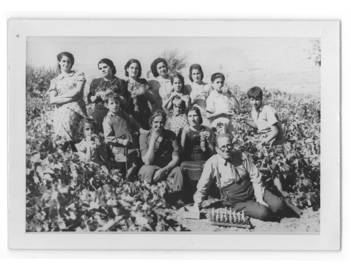
This
is my Mother’s family and the photo was taken in the mid-1930s in the vineyard
that my Grandpa owned. My grandma
is seated in the middle and my Mom is standing next to the two young boys on
the right. She was a teenager back
then. (She turned 89 last month.)
In
what follows, I will tell you a little more about Gaza’s diversity, and
also—by the way-- about the Gaza grapes that you see in this photo. I’ll do so by taking you many centuries
in the Past and then back to around the time the photo was taken. But, very importantly, I want you,
while listening, to contemplate a sentence that you’ve probably heard scores of
times in your life—Israel has made the Desert bloom.
Let
me start with a quote from Abba Eban, considered one of Israel’s greatest
statesmen and intellects:
·
He’s talking about the
origins of the Philistines, who are thought to have come to Southern Palestine
from the Aegean Region starting around 1200 BC: “Failing to penetrate into
Egypt, they obtained a foothold on the Palestine coast where they consolidated
their strength around five cities: Gaza, Ashkelon, Ashdod, Ekron and Gath. The Philistines occupied some of the
most fertile country of the region, and their resources were abundant.”
· (Another Israeli writer describing the
Fall of Gaza to the Persians in 538 BC wrote:) “Gaza [became] a terminus for
caravans of incense, myrrh and exotic animals from Yemen, …, Indian spices, [and]
Chinese silks … Greek and Cypriot ships [came to buy its] olive oil and wine.”
· (The same Israeli writer re the
period of Byzantine Rule (3rd to 6th centuries AD) : “Gaza
was regionally famous for its vegetables, dates, dried fruit and fish exports.
But [most of all] Gazan wine was renowned throughout the region and further.”
· Records of exports of high quality
Gaza wine extend back to antiquity.
Distinctive Gazan amphora (the ancient large ceramic jars with two
handles and a narrow neck, used to hold oil or wine) have been dug up all over
Europe and the Meditr’n Basin. By
the fifth century, the writings of several Latin historians in Western Europe
mention the high quality of wine imported from Gaza (paraphrased from Gerlad
Butt.)
· In 1154, the great Muslim geographer
al-Idrisi (who lived in what was then the predominantly Muslim city of Palermo,)
wrote about Gaza “it is a very populous city and in the hands of the
Crusaders.” (The Crusaders had
conquered Gaza from the Muslims who had earlier conquered it from the
Byzantines.) Around the year 1300
AD, the Syrian geographer, al-Dimashqi, described Gaza, now back under Muslim
rule, as a “city so rich in trees it looks like a cloth of brocade upon the
land.”
· Now back to twentieth century, the
British colonial High Commissioner wrote in a letter to the Foreign Office
describing the need to revive the Gaza economy, which under previous Ottoman
rule had been “a major supplier of barley for the brewing industry in
Europe.” (G. Butt, p. 120)
· In fact, Gaza did experience an
economic revival, with new neighborhoods being built in the 1930s and 1940s in the
southern and eastern plains, and along the Coast, with its verdant palm and
orange groves.
Clearly,
Gaza like the rest of Palestine, was not a desert which Israel made to bloom. Under a multiplicity of cultures that
came and went, all of them leaving an imprint on Gaza’s personality, the city
was generally known for its agricultural exports all over the Middle East and
beyond.
Next
I want to turn to some of Gaza’s periods of tolerance, particularly towards
Jews, to provide a contrast with Israel’s attitude towards Palestinians at the
present time. I will again rely on
quotations from Abba Eban’s book, My people: the story of the Jews. In listening to these quotations I ask you to think about
the “paradigm” of the Jewish state, as articulated by Chaim Weizman, one of its
leading Founding Fathers: When
Chaim Weitzman was asked about the goals of Zionism, his response was: “To
build up something in Palestine which will be as Jewish as England is
English."
But
here is what Abba Eban wrote to contrast the tolerance which Jews experienced
under Muslim rule, with the harsh conditions that Jews had experienced under
the former Christian Byzantine masters in the Middle East : “Under Muslim rule, world Jewry entered
into a new period of physical and intellectual expansion….The rejuvenation of
the [Jewish] community [in Palestine] under Muslim rule was …swift. Oppressed and numerically decimated by
its Byzantine sovereigns, the [Jewish] community in Palestine now rose to such
heights that it seemed ready to regain its authority over world Jewry”….[Jews
were allowed to return in large numbers to Jerusalem for the first time in
centuries.]
·
“Jerusalem was not the
only city to experience a [Jewish] renaissance under the Muslims…. [O]ther
centers of [Jewish] learning were Gaza, Ashkelon, and Haifa.”
Centuries
later, according to Eban and other Jewish historians, Jewish communities were
thriving among majority Muslim Arab populations in the Ottoman Middle
East.
Whie
preparing for this presentation I came upon several references to Jewish
minorities living and thriving in Gaza under majority Muslim rule. One such reference was actually from a
website of hardline Israeli settlers that referred Jewish barley merchants in
Gaza .
Gaza
flourished under Ottoman rule. The Jewish community was once again flourishing
and prosperous during the 16th and 17th centuries…. In the 19th century … [and
in 1665, on the occasion of Shabbatai Zevi’s visit to Gaza, the city became a
center of the messianic movement in Judaism…. [Later] in the 19th century, the
Jews that were concentrated there were mostly barley merchants. They bartered
with the Bedouins for barley which they exported to the beer breweries of
Europe.
(The
last sentence struck a chord with me.
My own family, several generations back, included prosperous barley
merchants in Gaza.)
Numerous other historical accounts validate the fact
that Christians, as well as Jews, not only were able to continue practicing
their religion under Muslim rule, but also witnessed periods of great
prosperity and cultural achievement.
Contrast
this tolerance with Chaim Weitzman’s Zionism which called for the creation of a
Jewish state in Palestine, effectively on the ruins of the indigenous Arab
Muslim and Christian population.
My
own family in Gaza, and many other Christian families were not only very large,
but played leading roles in the city’s commerce and administration under Muslim
rule.
Sadly,
in less than two generations, the brutality of Israel’s occupation has all but
wiped out Christian presence in Gaza.
Only a few of my relatives remain there, and there are hardly any youth
among them.
The
other speakers will tell you about the terrible conditions which have driven
young Palestinians, Christians and Muslims alike, to flee Gaza.
Not
all of Gaza’s history was rosy—not by a long shot. In fact, Gaza, being at the crossroads of
civilizations has had more than its fair share of war and man-made
calamity. Not a single group one
of its many historical creeds and ethnicities has been free of blame. As has been the case elsewhere,
Gaza’s periods of greatest prosperity were those when its leaders recognized
that its diversity was a source of strength. On the other hand, the people of Gaza, at times, experienced
untold massacres and near-complete destruction of their city. But Gaza has always risen from the
ashes, and I’m confident that it will do so again. And, when it does, it will again defy the myth that military
domination of one group over another brings security to the conqueror.